SOUTH AFRICAN BOERBOEL
BRC GLOBAL SOUTH AFRICAN BOERBOEL BREED STANDARD
BREED STANDARD CRITERIA The Breed Standard is a guideline which describes the ideal characteristics, temperament and appearance of the breed and ensures that the breed is fit for function. The aim of this Breed Standard is to provide guidelines to breeders, appraisers and judges, who should at all times be vigilant to avoid obvious conditions or excessiveness, that would be detrimental in any way to the health, welfare or absolute soundness of the Boerboel. Type, conformation, functional efficiency, mentality and composure are equally important in the evaluation of the Boerboel as a whole. The protective character of the breed is evident, as well as its impressive demeanour, good temperament, controllability and mobility. Although the Boerboel has become a popular breed internationally, the centre for breed specific knowledge remains in South Africa, as this is where its character is embedded. Faults: Any departure from the Breed Standard shall be considered a fault and the seriousness with which the fault shall be regarded, shall be in exact proportion to the degree and its effect on the health and welfare of the dog. Disqualification: Any serious deviations and/or combinations of deviations from the Breed Standard that may affect the dog’s health and/or performance negatively shall lead to disqualification at the discretion of the senior appraiser.
TEMPERAMENT AND CHARACTER The Boerboel is:
a) manageable, reliable, obedient, trainable and intelligent;
b) self-confident and fearless;
c) a dog with a strong protective instinct and loyal to members of the family;
d) shows courage when threatened;
e) steadfast and calm, with a balanced and confident nature when approached and
f) a dog requiring training and firm handling from an early age.
GENERAL APPEARANCE The Boerboel is:
a) a large dog with a strong-boned structure;
b) perfectly balanced within the desired proportions for the breed. The main structural components of the dog should show acceptable proportions to each other. The body is approximately 10 - 15% longer than the height (at the withers) and is measured horizontally, from the prosternum (breastbone) to a vertical line at the rear of the rump;
c) a dog with prominent and well-developed musculature;
d) impressive and imposing in appearance, created by a combination of conformation, carriage, confidence and powerful, buoyant and unencumbered movement - notwithstanding its size.
e) Males are distinctly masculine, larger and more heavily built with stronger bone, while females are distinctly feminine, but without weakness of substance or structure. Sexual dimorphism must be clearly evident.
f) The ideal height of a male is 66 cm with the minimum height of 60 cm.
g) The ideal height of a female is 61 cm with the minimum height of 55 cm.
h) Height must always be in relation to mass (the ideal ratio for a full-grown dog is approximately 1:1 – 1:1.2 cm per kg), overall balance and conformation of major body components
HEAD The shape and size of the head is a typical feature of the breed. The head is
a) large and typically Boerboel;
b) with no signs of another breed;
c) short, broad, deep, cube shaped - seen from all angles;
d) muscular and has well-filled cheeks;
e) in proportion with the rest of the body components and
f) the circumference equals the height to the withers (upper point of scapula)
Head characteristics are defined in terms of:
Skull
a) The skull is like a cube seen from all angles, large, and well muscled.
b) The width of the skull is equal to the length and depth thereof.
c) The length of the cranial roof (measured from the middle of the eye to the end of the occiput) must be relative to the length of the nasal bone in a ratio 2:1. The nasal bone should be a third of the total length of head.
d) The plateau is wide and flat with prominent musculature.
e) When the dog is alert, the upper level between the ears appears flat.
Face
a) The face gradually blends with the skull.
b) The face may be with or without a black mask
Ears
The ears are defined by:
a) Setting:
i. The earflaps are set high and wide.
ii. The earflaps are carried close to the head.
iii. When attentive, the top of the earflaps must form a straight line with the plateau.
b) Shape:
i. Obviously V-shaped;
ii. no creases and
iii. a broad base.
c) Size:
i. The earflaps are medium sized and in proportion to the head.
ii. The bottom edge of the earflap is in line with the dentition
Eyes
The eyes are defined by:
a) Size and setting:
i. Medium sized, rounded, forward facing, and widely spaced;
ii. set on the same horizontal level and
iii. not protruding or deep set.
b) Eyelids:
i. Firm, well pigmented;
ii. no structural deviations such as entropion, ectropion, distichiasis or signs of surgical intervention and
iii. not slanted.
iv. The third eyelid (haw) should not be visible.
c) Colour: The colour of the eye is any shade of yellow or brown
Stop
a) The stop is visible, but not prominent/pronounced or absent.
b) The section between the eyes is well filled
Nasal bone (Muzzle)
The nasal bone is defined by:
a) Shape:
i. Deep, broad, cube shaped, and tapers slightly towards the front, but not snipey. ii. Straight and parallel to the line of the cranial roof.
iii. Well attached and filled below the eyes.
iv. The nostrils are large and widely spaced.
b) Width and depth:
i. The width is almost equal to, but less than the length.
ii. The depth should equal the length.
c) Length: The nasal bone is in proportion to the head, and measures approximately a third of the total length of the head, i.e. approximately 10 cm for a male of 66 cm and 8 cm for a female of 61 cm.
d) Pigmentation: The nose leather is black
Lips
a) The upper lip (under the nose) just covers the top of the lower lip and teeth. b) The upper lip does not extend below the lower jawline.
c) The lower lip is moderately tight (not too loose and fleshy), without open or excessive lip
Teeth
a) Dentition is complete.
b) Teeth are correctly spaced.
c) Teeth are ideally in a scissor bite
Jaws
The jaws are strong, deep and broad and taper slightly towards the front
NECK
The neck is defined by:
a) Shape
i. Forms a unit with the head and the shoulders; and with
ii. a discernible muscular crest.
b) Length The neck is of medium length and in proportion to the rest of the dog. The length equals about 1/3 of the height at the withers.
c) Scruff and dewlap
i. The scruff is loose.
ii. The dewlap is noticeable and loose from under the chin.
iii. The dewlap becomes taut between the front legs
FOREQUARTER The forequarter is well muscled and correctly angulated from the well-sloped shoulder blade down to the elbow at an angle of approximately 90° - 100̊. The forequarter characteristics are defined in terms of
Chest The chest is:
a) strong, muscular and broad;
b) well pronounced and placed deep between the front legs with good volume; c) the point of the prosternum is level with the point of the shoulder.
Shoulders
The shoulder blades are well attached with an approximate 70 mm space in between.
Elbows
a) The elbows are stable, parallel to and carried close to the body when in a stationary position and during movement, not limiting the optimal volume of the centre piece/torso.
b) The height of the elbows is equal to ½ of the height at the withers.
Front legs
The front legs:
a) have a substantive bone structure;
b) are thick, strong and sturdy;
c) have a well-defined musculature on the in- and outside of the upper legs and d) are vertical, as seen from the front and the side.
Pasterns
The front pasterns are: a) short, strong and of adequate girth as seen from the front and the side and
b) are a vertical extension of the front legs as seen from both the front and the side, but slanting forward at a slight angle.
Front paws
The front paws are defined by:
a) Size: The front paws are large in circumference.
b) Shape:
i. Well padded, ball shaped and tight;
ii. strong, curved, with dark pigmented toenails.
c) Tread: The front paws point and tread straight forward
CENTRE PIECE
The centre piece (torso) must be of adequate width and depth with a level, straight top line and a slight abdominal tuck-up. The length of the ribcage, loin and croup (rump) is approximately proportioned (2:1:1). The centre piece characteristics are defined in terms of:
Ribcage
The ribcage (the area from the first chest vertebrae to the last rib bone)
a) is well sprung with a deep, rounded brisket;
b) must ideally have a length proportion of 2:1 to the loin;
c) the depth is equal to ½ the total height of the dog at the withers, descending slightly below the elbow;
d) is filled behind the shoulder blades and elbows.
Back
The back (from a point behind the withers/top of the scapula to the last rib bone) is:
a) broad;
b) flat;
c) straight and
d) well muscled.
Loin
The loin (from the last rib bone to the front of the primary thigh) is:
a) of adequate depth (slightly less than the length of the loin);
b) short (ideally ⅓ of total torso length); c) wide as seen from the top;
d) flat when seen from the side;
e) strong and muscular and
f) moderately tucked up
Top line
a) The top line (from a point behind the withers to the beginning of the croup) is straight without any deviations.
b) A very slight, non-flexible dip just behind the shoulders is normal.
HINDQUARTER
The hindquarter is broad, of substantial depth, well muscled, in proportion to the rest of the dog and correctly angulated. The hindquarter characteristics are defined in terms of:
Croup
The croup is:
a) of adequate length, broad, strong/muscular;
b) correctly angulated and slopes slightly towards the haunch;
c) the height should not exceed the height at the withers
Tail
a) The tail is a natural extension of the spinal cord. It should therefore be set fairly high, and of adequate girth.
b) Subject to the legislation applicable to the breeder of a dog, both docked and long tails are acceptable.
c) Long tails should be sabre shaped and should reach approximately to the hocks when the dog is standing.
d) Docked tails should ideally be docked at the third caudal vertebrae, leading to an ideal adult tail length of about 8 cm and straight.
Primary/Upper thighs
The upper thighs are broad, deep and with well-developed muscular definition when viewed from the side and the rear. Secondary/Lower thighs
The lower thighs are well developed and display adequate, visible musculature down to the hock.
Stifles (Knees)
a) The stifle joint is strong and firm.
b) The angulation between the femur, tibia and fibula must be approximately 90°-100̊ as seen from the side
Hocks
a) The hock joints are strong and stable; b) correctly angulated as seen from the side without lateral deviation when standing or moving; and
c) parallel with each other when viewed from the rear.
Pasterns
a) The hind pasterns are relatively short, strong and of adequate girth.
b) When viewed from behind, they are parallel with one another.
c) When viewed from the side, they are vertical.
d) The front of the hind pastern is in line with the back of the haunch.
e) Dewclaws may be removed.
Hind paws
a) The hind paws are as the front paws but should be slightly smaller than the front paws.
b) The hind paws point and tread straight to the front
SKIN
The skin:
a) is moderately thick and loose; and
b) should show black eumelanin pigmentation.
c) There are moderate wrinkles on the brow when the dog is attentive.
COAT
a) The coat should be sleek with dense hair coverage.
b) The recognised colours are:
i) All shades of fawn, brown, tan and red ii) Black
iii) Brindle (brindle being a colour pattern with irregular apparent vertical lines of only black hair on a fawn, brown, tan or red base colour)
c) All the colours and associated patterns should be accompanied by good pigmentation.
d) No other colours or colour patterns or markings are acceptable.
e) Undesirable colours are:
i) More than a third white of the total body surface is unacceptable as it may influence pigmentation.
ii) Excessive/large white areas in all colours are undesirable, and must be eliminated.
(Definitions: “Unacceptable” means: Disqualification)
PIGMENTATION
The Boerboel is well pigmented, especially on the lips; nose; palate; the skin and hair around the eyes; footpads; toenails; the anus, the nipples and the skin and hair around the genitals.
GENERAL HEALTH
The general health of the Boerboel is of a high standard. Animals presented for appraisal must be in a good general condition and weight must be in relation to the size of the dog. Physical handicaps and former surgery must be supported by acceptable certification.
Reproductive organs
Both females and males should have at least eight nipples.
a) Males
i. Male dogs must have two well-developed testicles, both in the scrotum. ii. The penile sheath is short and firm and holds the penis close to the body.
iii. Castrated males, monorchids or cryptorchids, may be taken up in the Pet Register.
iv. Castrated males, monorchids or cryptorchids are not allowed in the show ring.
b) Females
i. The vulva must be firm.
ii. Sterilised females may be taken up in the Pet Register.
iii. Sterilised females are not allowed in the show ring
MOVEMENT
a) The movement is balanced, effortless, though powerful, purposeful, buoyant and fluent with comfortable reach in the front and powerful drive from the rear.
b) The stride is sufficient, long, free and unrestricted.
c) The legs move on parallel planes at all times. Whilst converging to the centre line of travel, the legs should never cross.
d) At all gaits the top line is stable (fixed), without any swaying, dipping or excessive body roll.
e) Limited, weak or unsound movement shall be severely penalised.
Traits that shall lead to disqualification are:
a) Any indication of another dog breed
b) Temperament Any behavioural abnormalities, i.e.
i. An overly aggressive and/or uncontrollable dog.
ii. A timid or insecure dog.
iii. A dog that bites its owner.
c) Size
i. A dog not meeting the prescribed height.
ii. A dog with insufficient bone structure. iii. A petite dog.
iv. A clumsy/unbalanced dog.
v. Unacceptable proportions of body components.
d) Head
A head that is not typically Boerboel.
i. A too small or nondescriptive head.
ii. Erect or semi-erect ears. Serious erect ears
iii. Serious structural deviations of the eyelids.
iv. Any other colour than yellow or brown eyes.
v. A nose leather that is not black
vi. Excessive deviations of dentition
vii. A narrow, too long or sharply pointed muzzle.
viii. A dog with cropped ears
Body
i. A chest that is too narrow.
ii. Bandy or crooked legs.
iii. A top line that is too hollow.
iv. A top line that is roached.
v. A top line that is S-curved.
vi. Serious cow hocks.
vii. Serious sickle hocks
viii. Slipping (unstable) joints.
ix. Straight hind legs.
x. Deformed spines.
xi. Kinked, corkscrew, deformed or tightly curling tails.
f) Skin and pelt
i. Long and/or curly hair.
ii. Excessive skin.
iii. Insufficient pigmentation of skin around key areas (lips; nose; palate; the skin and hair around the eyes; footpads; toenails; the anus; the nipples; and the skin and hair around the genitals.
Colour
i. Unacceptable colours and patterns in respect of the breed standard:
• Liver colour on any basic breed standard colour.
• Excessive ticking on any basic breed standard coat colour.
• Split face on any basic breed standard colour.
• Dilute powder and solid blue colour dogs.
• Black-and-tan dogs.
• More than a third white of the total body surface.
• The black colour needs to be a strong black colouring with no shades of brown (referred to as seal colouring).
• Tri-colour
• Any colours not part of the Breed Standard.
ii. Insufficient pigmentation
Reproductive organs
i. Males without two natural and well-developed testicles.
ii. Females with grade 2 vaginal hyperplasia or a prolapse.
Mobility
i. Clumsy or unbalanced movement.
ii. Any visible impairment that seriously affects mobility.
iii. Physical handicaps which are not the result of an earlier injury.
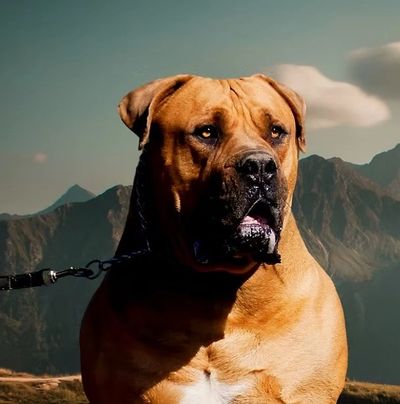
Perro de Presa Canario
BRC GLOBAL PERRO DE PRESA CANARIO STANDARD
The ancestors of the Perro de Presa Canario were probably brought to the Canary Island by the Spanish Conquistadors, and coexisted with indigenous cattle dogs from the beginning of the fifteenth century. These dogs served many purposes. They guarded the farms, helped catch and hold cattle, and exterminated wild or stray dogs. In the 1940s, the breed began to decline in numbers. It was revived again in the 1970s, when reputable breeders developed and bred Presas true to their original size and character
General Appearance
The Presa Canario is a moderately large, powerfully constructed dog with a harsh-textured, flat coat. The head is massive and cuboid. Ears are set just above the line of the eye and may be cropped, naturally pendent or rose. The body of the Presa Canario is slightly longer than its height at the withers, with a broad, deep chest, but females may be slightly longer and possess somewhat less rib spring than the males. Skin is thick and elastic. The distance from the withers to the elbow is roughly equal to the distance from the elbow to the ground. The tail is very thick at the base, and tapers to a point. The tail is moderately high and reaches to the hock. The overall impression is that of an imposing, solid guard dog.
Characteristics
The essential characteristics of the Presa are those which enable it to drive and hold cattle, and to guard its home and family. These tasks require a powerful, agile, courageous dog with a large head and powerful jaws. The Presa is extremely affectionate, docile and well behaved with its owner and family, but is wary of strangers and aggressive with other dogs.
Serious Fault: Unstable temperament
Head
The head is massive, cuboid (cube-like) in shape. When viewed from the side, the top lines of the skull and muzzle are roughly parallel to one another, and are joined by a well-defined, but not abrupt, stop. When the dog is alert, the skin forms several symmetrical wrinkles in the median furrow.
Fault: Excessive wrinkling.
Serious Faults: Skull and muzzle not in correct proportion, abrupt stop.
SKULL
The skull is cube-shaped, broad and slightly domed, but without occipital protuberance. The width of the skull is about 3/5 of the length from occiput to nose. Zygomatic arch is very pronounced and there is a deep median furrow that diminishes in depth from the stop to the occiput. Cheek muscles are well developed without being pronounced.
MUZZLE
The muzzle forms a smaller cube that tapers just slightly from stop to nose. The length of the muzzle is roughly 2/5 of the length of the head, while the width is about 2/3 as wide as the skull. The bridge of the muzzle is flat and straight. Lips are moderately thick and pendulous with black pigment. The top lip should fall naturally over the lower without excessive flews. Viewed from the front, the lips form an inverted V where they join.
TEETH
The Perro de Presa Canario has a complete set of evenly spaced teeth, set in a wide jaw. A scissors or reverse scissors bite is preferred. A level or slightly undershot bite is acceptable.
Fault: Missing any tooth other than the first premolar.
Serious Fault: Excessively undershot bite.
Disqualification: Overshot bite.
NOSE
The nose is wide and black. In profile, the nose fits cleanly into the square formed by the nasal bone and the front plane of the muzzle. The nose does not protrude beyond the front plane of the muzzle, which would give a snipey look to the head.
EYES
Eyes are slightly oval, set level and wide apart, and range in color from medium to dark brown, in accordance with coat color. Eyelids are close-fitting and black.
Serious Faults: Light eyes, droopy eyelids, eyes set close together or obliquely.
Disqualifications: Blue, gray, or yellow eyes, non-matching eyes.
EARS
Ears are of medium size, set just above the line of the eye and wide apart, and covered with short, fine hair. Ears may be natural or cropped. The natural ears may be pendent or rose. Pendent ears drop effortlessly to the sides of the head, and rose ears are close fitting. Cropped ears are erect.
Fault: High set ears.
Neck
The neck is cylindrical, thick, well muscled, and slightly shorter than the length of the head. Loose folds of skin at the throat form a slight dewlap.
Serious Faults: Excessive dewlap, long or weak neck.
Forequarters
Shoulders are muscular and well laid back. The upper arm is of good length and well-angled so that the front legs are set well behind the point of the shoulder. The elbows must be neither too close to the ribs or sticking out.
FORELEGS - Front legs are straight, well muscled, and heavy boned. Pasterns are strong, short, and nearly vertical.
Body
A properly proportioned Presa is about 20-percent longer (measured from prosternum to point of buttocks) than tall (measured from the withers to the ground), and length of the front leg (measured from point of elbow to the ground) should approximately equal one-half of the dog's height. Females may be slightly longer in body. The withers are slightly elevated. The back and loin are strong but without prominent musculature. The straight topline ascends slightly toward the croup. The height at the croup is no more than three-fourths inch of the height at the withers. The croup is of medium length, wide and slightly sloping. Females normally have slightly wider croups. The loin is moderately short, muscular and deep, with moderate tuck-up. The ribs are well arched. The brisket extends to the elbow. The chest is broad and deep with well-developed pectoral muscles. Ideally, the circumference of the deepest part of the chest should equal almost 1 and one half times the dog's height at the withers.
Disqualification: Croup lower than withers, height at the croup notably higher than the withers.
Hindquarters
Hindquarters are powerful and well-muscled. In profile, the croup is sloping. The turn of stifle is moderate with a good bend to the knee. When the dog is standing, the rear pasterns are short, perpendicular to the ground and, viewed from the rear, parallel to one another.
Serious Faults: Severe over angulation, sickle hocks, cow hocks.
Disqualification: Straight rear legs lacking bend of knee.
Feet
Feet are round, compact, cat-like. Rear feet are slightly longer than the front. Pads are well developed, tight, black, not splayed. Nails are solid color, white or black depending on coat color of toes.
Fault: Fault: Splayed feet, flat feet.
Tail
The tail is a natural extension of the topline, set moderately high. It is thick and muscular at the base, and tapers to a point. A tail of the correct length extends to the hock but never below. Tail carriage ranges from a pump handle tail when the dog is relaxed to a saber tail when the dog is alert.
Serious Faults: Fine tail, curly or blunt tail, low tail set.
Disqualification: Docked tail.
Coat
The Presa has a short, flat single coat that is harsh in texture. It is very short and fine on the ears and slightly longer on the withers and the back of the rear hindquarters.
Disqualification: Any color or pattern other than those described.
Serious Faults: Satiny, fine coat.
Color
Any shade of fawn, black, and brindle in any combination of these colors. The face must have a black mask that does not extend over the eyes, with or without a white blaze or patch on the head. Minimal white markings may appear anywhere between the chest and the throat, or on the toes.
Serious Fault: Mask that extends over the eyes or masks covering less than 50-percent of the face muzzle.
Disqualifications: Absence of black mask, white markings covering more than 20-percent of the dog, coat color or pattern other than described above.
Size
Desirable height at withers for a mature male is 23-26 inches. Desirable height at withers for a mature female is 22-25 inches, with a tolerance of 1 inch over these limits being acceptable. Minimum weight for a mature male is 100 pounds with a maximum weight of 125. Minimum weight for a mature female is 85 pounds with a maximum of 100 pounds.
Gait
When trotting, the stride is long, effortless and well coordinated and the tail is carried above the topline.
Disqualifications
Unilateral or bilateral cryptorchid.
Viciousness or extreme shyness.
Overshot bite.
Blue, gray, or yellow eyes.
Non-matching eyes.
Croup lower than withers.
Docked tail.
Absence of dark mask.
White markings covering more than 20% of the dog.
Coat color or pattern other than described in Color paragraph above.
Albinism.

pug
BRC GLOBAL PUG BREED STANDARD
General Appearance: Symmetry and general appearance are decidedly square and cobby. A lean, leggy Pug and a dog with short legs and a long body are equally objectionable. Size, Proportion, Substance: The Pug should be multum in parvo, and this condensation (if the word may be used) is shown by compactness of form, well knit proportions, and hardness of developed muscle. Weight from 14 to 18 pounds (dog or bitch) desirable. Proportion square. Head: The head is large, massive, round - not apple-headed, with no indentation of the skull. The eyes are dark in color, very large, bold and prominent, globular in shape, soft and solicitous in expression, very lustrous, and, when excited, full of fire. The ears are thin, small, soft, like black velvet. There are two kinds - the "rose" and the "button." Preference is given to the latter. The wrinkles are large and deep. The muzzle is short, blunt, square, but not upfaced. Bite - A Pug's bite should be very slightly undershot. Neck, Topline, Body: The neck is slightly arched. It is strong, thick, and with enough length to carry the head proudly. The short back is level from the withers to the high tail set. The body is short and cobby, wide in chest and well ribbed up. The tail is curled as tightly as possible over the hip. The double curl is perfection. Forequarters: The legs are very strong, straight, of moderate length, and are set well under. The elbows should be directly under the withers when viewed from the side. The shoulders are moderately laid back. The pasterns are strong, neither steep nor down. The feet are neither so long as the foot of the hare, nor so round as that of the cat; well split-up toes, and the nails black. Dewclaws are generally removed.
Hindquarters: The strong, powerful hindquarters have moderate bend of stifle and short hocks perpendicular to the ground. The legs are parallel when viewed from behind. The hindquarters are in balance with the forequarters. The thighs and buttocks are full and muscular. Feet as in front. Coat: The coat is fine, smooth, soft, short and glossy, neither hard nor woolly. Color: The colors are fawn, silver apricot or black The colors are clearly defined for strong contrast. The fawn color should be decided so as to make the contrast complete between the color and the trace and mask. Markings: The markings are clearly defined. The muzzle or mask, ears, moles on cheeks, thumb mark or diamond on forehead, and the back trace should be as black as possible. The mask should be black. The more intense and well defined it is, the better. The trace is a black line extending from the occiput to the tail. Gait: Viewed from the front, the forelegs should be carried well forward, showing no weakness in the pasterns, the paws landing squarely with the central toes straight ahead. The rear action should be strong and free through hocks and stifles, with no twisting or turning in or out at the joints. The hind legs should follow in line with the front. There is a slight natural convergence of the limbs both fore and aft. A slight roll of the hindquarters typifies the gait which should be free, self-assured, and jaunty. Temperament: This is an even-tempered breed, exhibiting stability, playfulness, great charm, dignity, and an outgoing, loving disposition.

Cane Corso
BRC GLOBAL CANE CORSO STANDARD
General Appearance: Ancient Italian breed medium-large size Molossus Dog. Sturdy, with a strong skeleton. Muscular and athletic, it moves with considerable ease and elegance. It has always been a property watchdog and hunter of difficult game such as the wild boar. Size, Proportion, Substance: A muscular, balanced, large-boned dog, rectangular in proportion. The length of the dog, measured from the point of the shoulder to the point of buttock is approximately 10 percent greater than the height of the dog measured from the highest point of the shoulder to the ground. Height - Dogs 25 to 27½ inches; bitches 23½ to 26 inches. Weight - Proportionate to height. Head: Molossus, large, its total length reaches approximately one third of the height at the withers. Planes of the skull and muzzle are slightly convergent; they are not parallel. The circumference of the head measured at the cheekbones is more than twice the total length of the head; skin is firm and smooth. Skull - Viewed from the front, skull is wide and slightly curved; width is equal to the length. From the side, a prominent arch begins above the eyes and then flattens backward toward the occiput. Viewed from the top, it has a square appearance due to the zygomatic arches and powerful muscles swathing it. Stop - Well-defined due to developed and bulging frontal sinuses and prominent arch above the eyes. Expression - Very alert and attentive. Some wrinkling on forehead occurs when alert. Eyes - Medium-size, almond-shaped, not round or bulging, tight fitting rims preferred with only a minimal amount of haw being visible. Eye color-Dogs with black muzzles (coat colors of black, fawn or red, and these colors brindled) dark brown eyes are preferred. Gray muzzles (coat colors of gray, fawn or red and these colors brindled), lighter shades are approved. Pigmentation of the eye rims is complete, pigmentation of eye rim matches pigment color of dog. Disqualification - Yellow bird of prey; blue eyes Ears - Set well above the cheekbones. May be cropped or uncropped. If cropped, it is in an equilateral triangle. If uncropped, they are medium size, triangular in shape, held tight to the cheeks, and not extending beyond the jaw bone. Nose - Large with well-opened nostrils, pigment color to match pigment color of the dog. Dogs with black pigment have black noses; gray pigmented dogs have gray noses; pigmentation is complete. The nose is an extension of the topline of the muzzle and does not protrude beyond nor recede behind the front plane of the muzzle. Muzzle - Very broad and deep, width is almost equal to its length, which reaches approximately one third of the total length of the head; the depth of muzzle is more than 50 percent of the length of the muzzle. The top and bottom muzzle planes are parallel, and the nose and chin form a perpendicular line. Viewed from the front, the anterior face should look flat and form a trapezoid, wider at the bottom. Muzzle is not overly narrow or snipey. Lips - Rather firm. Upper lips moderately hanging, they join under the nostrils to form an inverted "U." Pigmentation matches color pigment of dog. Dogs with black pigment have black lips; gray pigmented dogs have gray lips. Bite - Slightly undershot (no more than ¼ inch) and level preferred. Scissor bite is acceptable, if parameters of the head and muzzle are correct. Dentition is complete. Incisors are in a straight line. No more than two missing teeth. Disqualification - More than two missing teeth; wry mouth. Undershot more than ¼ inch. Neck, Topline, Body: Neck-Slightly arched, flowing smoothly into the shoulders with a small amount of dewlap. The length of the neck is approximately one third the height at the withers. Body - Depth of the ribcage is equal to half the total height of the dog, descending slightly below the elbow. Ribs are long and well sprung. Moderate tuck up. Chest - Broad, well-muscled, strong forefront. Back - Wide, strong, muscular. Highest part of shoulder blade slightly rising above the strong, level back. Loin - Well-muscled, and harmoniously joined to the back. Croup - Long, wide, slightly sloping. Rump should be quite round due to muscling. Tail - Tail set is an extension of the backline. It is thick at the root with not much tapering at the tip. When not in action, carried low, otherwise horizontal or slightly higher than back, not to be carried in a vertical position. It is docked at the fourth vertebrae. In the case of natural tails, the tip reaches the hock but not below. Carried low, it is neither broken nor kinked but supple. Hanging when the dog is in repose; generally carried level with the back or slightly above the level of the back when the dog is in action, without curving over the back or being curled. Disqualification - A natural tail that is atrophied or a natural tail that is knotted and laterally deviated or twisted. Forequarters: Strong and muscular, well-proportioned to the size of the dog. Straight when viewed from the front or side; height of the limb at the elbow is equal to 50 percent of the height at the withers. Shoulders- Muscular, laid back. Upper arms - Strongly muscled, with good bone, powerful. Elbows - Held parallel to the ribcage, turning neither in nor out. Forelegs - Straight and with good bone, well muscled. Pasterns - Almost straight, strong but flexible. Feet - Round with well-arched toes (catlike). Lean, hard, dark pads and nails, except in the case of white toes. Front dewclaws - Can remain or be removed, if left intact should only be a single dewclaw on each leg. Hindquarters: As a whole, they are powerful and strong, in harmony with the forequarters. Straight when viewed from the rear or front. Thighs - Long, wide, angulated and well-muscled. Stifle - Should be moderately angulated, strong. Legs - Strong bone and muscle structure. Hocks - Wide set, thick and clean, let down and parallel when viewed from behind. Rear pastern - straight and parallel. Rear dewclaws - Any rear dewclaws are removed. Hind feet - Slightly more oval-shaped and less-arched toes. Coat: The coat is short, stiff, shiny, adherent and dense with a light undercoat that becomes thicker in cold weather Color: Acceptable colors are black, lighter and darker shades of gray, lighter and darker shades of fawn, and red. Brindling is allowed on all of these colors. Solid fawn and red, including lighter and darker shades, have a black or gray mask. The mask does not go beyond the eyes. There may be a white patch on the chest, throat, chin, backs of the pasterns, and on the toes. Disqualification - Any color with tan pattern markings as seen in black-and-tan breeds. Gait: The movement is free flowing and powerful, yet effortless, with strong reach and drive. As the dog accelerates, the feet converge toward a center line of gravity in a near-single track. When viewed from the side, the topline remains level, with minimal roll or bounce. Temperament: The Cane Corso as a protector of his property and owners is unequaled. Intelligent, he is easily trained. Noble, majestic and powerful his, presence is impressive. He is docile and affectionate to his owner, loving with children and family. Summary: The overall conformation of the dog should be well-balanced and proportionate. The foregoing description is that of the ideal Cane Corso; any deviation from the above described dog is penalized to the extent of the deviation. Disqualifications: Yellow bird of prey; blue eyes. More than two missing teeth; wry mouth. Undershot more than ¼ inch. Any color with tan pattern markings as seen in black-and-tan breeds. A natural tail that is atrophied or a natural tail that is knotted and laterally deviated or twisted
